
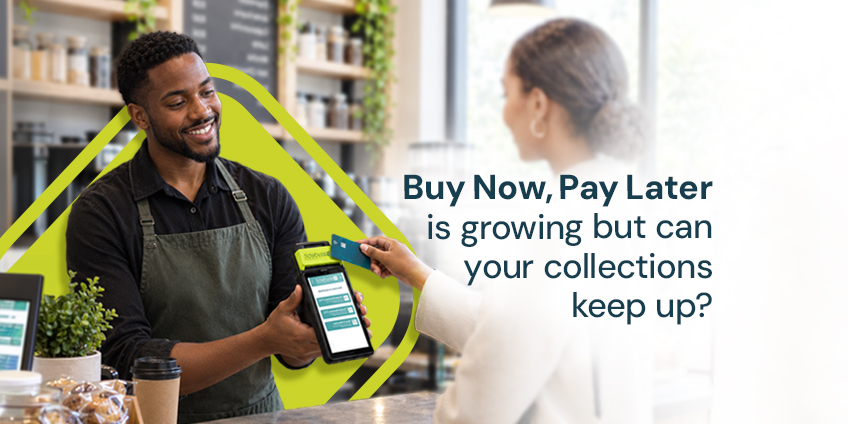
Buy Now, Pay Later (BNPL) is moving from a ‘new niche’ payment option to a mainstream way for South Africans to manage purchases. Everyone seems to be doing it (both businesses and customers), however, nobody is talking about what happens next. As the use for BNPL grows, so does the pressure on providers to collect repayments consistently, manage risk and create payment journeys that work for both businesses and customers.
This method has successfully made flexible payments more available and more accessible but now the challenge is making sure the systems behind those payments do not crumble.
So, when more customers choose to pay later, can businesses still make sure they get paid on time?
The Current State of BNPL in South Africa
BNPL has gained significant traction among South African consumers with more than half the country already locked in. TransUnion’s Q4 2025 Consumer Pulse Study found that 57% of South African respondents held a BNPL product, while 36% had used BNPL multiple times in the previous 12 months. [1]
The demand for flexible payment options is also showing up in merchant behaviour. Payfast’s 2025 State of Pay study found that BNPL was the most requested new payment method among consumers, with 34% asking merchants to offer it. BNPL’s share of online payment usage also doubled from 3% in 2024 to 6% in 2025. [2]
Market research points to further growth. PayNXT360 estimated that South Africa’s BNPL payment market would reach approximately US$815.1 million in 2025, following a 23.5% compound annual growth rate between 2021 and 2024. The market is forecast to continue expanding through 2030. [3]
The appeal is easy to justify as BNPL allows consumers to receive goods immediately while spreading the cost over a short period, often through interest-free instalments when payments are made on time. For merchants, it can provide another way to improve affordability and encourage purchases.
However, this growth creates the question:
What happens after the sale?
For BNPL providers, the customer journey does not end at checkout. Repayments still need to be collected and that makes the underlying payment infrastructure a critical part of the model. So, as BNPL adoption grows, can providers maintain convenient customer experiences while keeping collections secure, reliable and scalable?

Why Collections Matter to the BNPL Model
BNPL is different from a traditional once-off card transaction. Instead of receiving the full payment directly from the customer at checkout, the provider typically manages the repayment process while the merchant receives payment upfront, depending on the BNPL model. This means the provider takes on the associated collection and default risk. [4]
The South African Reserve Bank has highlighted this risk in its 2026 Financial Stability Review. It notes that BNPL can contribute to over-indebtedness because consumers may hold multiple BNPL obligations at the same time, while the short-term nature and rapid approval of these products can make them different from traditional forms of credit. [4]
This makes successful collections particularly important. A provider can win a thousand new customers this month but if repayment performance does not keep pace, the economics of that growth can come under pressure.
There is also a customer-experience consideration. BNPL works partly because it is convenient. If the repayment process becomes complicated, customers may struggle to complete required actions, miss payment requests or encounter failed payments. That creates a balancing act for providers to make the payment process secure enough to protect customers and businesses, while keeping it simple enough to support successful collections.

What BNPL Providers and Recurring-Payment Businesses Need to Consider
In 2026, the National Credit Regulator moved to require BNPL providers to begin reporting consumer payment behaviour to credit bureaus from February 2027. [5] The change reflects the growing importance of BNPL within the broader credit ecosystem and means repayment behaviour will increasingly have consequences beyond the individual transaction.
For businesses operating in this environment, collections cannot be treated as an afterthought. The payment process needs to work from the initial mandate or transaction right through to the final repayment.
A strong collections process should make it easier to:
Verify the customer and their account: Before collecting, businesses need confidence that they are dealing with the right customer and the right bank account. EasyAVS can verify bank account details in real time, helping businesses reduce the risk of invalid accounts and failed collections.
- Get mandates authorised: Once the customer is ready to enter into a recurring payment arrangement, DebiCheck enables customers to electronically authenticate their debit-order mandates before collections begin.
- Choose when to collect: Having an authorised mandate does not guarantee that funds will be available on collection day. Strike Date Optimisation helps businesses identify when customers are most likely to have funds available, supporting higher collection success rates.
- Manage and track collections: As payment volumes increase, businesses need visibility over what has been collected and what still requires attention.
- Manage lending and repayments at scale: For microlenders specifically, EasyDebit Loan Manager brings loan origination, payment management, collections and recovery, servicing, analytics and reporting into one platform.
These considerations extend beyond BNPL. They are relevant to any business that relies on recurring payments, including lenders, schools, gyms, subscription businesses and other service providers.
The broader South African payments landscape is also moving towards greater interoperability, accessibility and digital adoption. The SARB’s Payments Ecosystem Modernisation Programme identifies the need for payment systems that are fast, simple, inclusive and secure, while improving interoperability across the ecosystem. [6]
The opportunity for businesses is therefore not simply to offer more payment options. It is to build payment processes that make those options easier and more reliable to use.

[1] TransUnion South Africa, “SA’s Consumer Credit Market Shifted from Recovery to a More Stable Position in Q4 2025,” 2026. https://newsroom.transunion.co.za/sas-consumer-credit-market-shifted-from-recovery-to-a-more-stable-position-in-q4-2025/_
[2] Business Day, “Buy now, pay later use doubles in 2025, Payfast reports,” 2026.https://www.businessday.co.za/companies/2026-01-20-buy-now-pay-later-use-doubles-in-2025-payfast-reports/
[3] PayNXT360, “South Africa Buy Now Pay Later Business and Investment Opportunities – Q1 2025 Update,” 2025.https://www.marketresearch.com/PayNXT360-v4075/South-Africa-Buy-Pay-Later-40576433/
[4] South African Reserve Bank, “First Edition 2026 Financial Stability Review,” 2026.https://www.resbank.co.za/content/dam/sarb/publications/reviews/finstab-review/2026/first-edition/first-fsr-june.pdf?
[5] Times Live, “Buy-now-pay-later users face tougher credit checks,” 2026.sundaytimes.timeslive.co.za/business/2026-08-15-bnpl-users-face-new-credit-scrutiny/
[6] South African Reserve Bank, “Payments Ecosystem Modernisation Programme,” 2026.https://www.resbank.co.za/en/home/what-we-do/payments-and-settlements/pem?